
Becoming a Certified Supply Chain Professional (CSCP) | Guide
Becoming a Certified Supply Chain Professional (CSCP) | Guide
Introduction: What Is a Certified Supply Chain Professional?
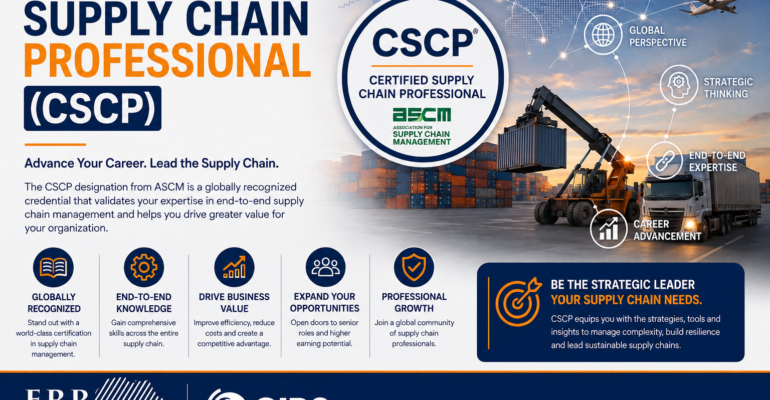
The Certified Supply Chain Professional (CSCP) credential validates a practitioner’s ability to manage end-to-end supply chains, from raw materials through final delivery to the customer. CSCP certification covers end-to-end supply chain management, spanning demand forecasting, sourcing, production, logistics, risk, and technology. The credential is recognized globally in supply chain management, with over 125,000 holders across North America, Europe, the Middle East, and Asia-Pacific.
In 2026, the median base salary for U.S. supply chain professionals sits at US $98,500, and CSCP-certified professionals earn an average of 21% more than their non-certified peers. Roles that favor or require the cscp designation include global supply chain manager, operations director, logistics manager, and S&OP planner.
Core outcomes of earning the CSCP:
Career growth into senior chain management roles with broader scope
A strategic, cross-functional perspective on global supply chain operations
Global recognition that transfers across industries and borders

What Is the APICS Certified Supply Chain Professional (CSCP)?
The APICS Certified Supply Chain Professional credential is awarded by the Association for Supply Chain Management (ASCM), formerly known as APICS. ASCM launched the CSCP in 2006 to certify professionals who understand key concepts and strategies for managing global supply chain networks. The Certified Supply Chain Professional (CSCP) is a globally recognized credential that differs from other ASCM certifications: CPIM focuses on internal operations and inventory management; CLTD specializes in logistics, transportation, and distribution; CTSC targets digital transformation and change leadership.
CSCP covers the full spectrum: supply chain strategy and design, supply chain planning, execution, and continuous improvement. It is vendor-neutral and industry-agnostic, making it applicable across manufacturing, healthcare, retail, technology, and services.
Scope: end-to-end supply chain processes, from supplier selection to customer fulfillment
Credibility: backed by ASCM, the largest supply chain management professional body worldwide
Recognition: holders work across North America, Europe, Middle East, and Asia-Pacific in roles requiring supply chain concepts and cross functional collaboration
Who Should Become a Certified Supply Chain Professional?
The CSCP fits professionals whose work spans multiple supply chain activities rather than a single function. If your role involves coordinating sourcing, production, logistics, or demand planning across sites or countries, the credential matches your scope.
Demand planning analyst or S&OP planner: needs to connect demand forecasting with supply chain planning and supplier management across regions
Global supply chain manager: oversees cross-site supply chain operations, balancing cost, speed, and resilience
Logistics manager at a multinational: coordinates international logistics, transportation modes, and warehouse management across borders
Operations supervisor moving into strategy: wants a deep understanding of how supply chain network design affects customer satisfaction and reducing costs
Professionals transitioning from finance, engineering, or IT: supply chain management principles bridge technical skills with operational context; an engineer focused on statistical process control or a data analytics specialist gains the supply chain breadth employers seek, and a formal diploma in supply chain management can further strengthen foundational skills before pursuing CSCP

Eligibility Requirements for the CSCP Exam
ASCM has removed formal eligibility prerequisites for the CSCP exam. As of 2026, anyone can register and sit for the exam without submitting proof of education or work experience. This is a change from earlier requirements that mandated a bachelor’s degree plus supply chain experience, or several years of related business experience.
No prerequisite: create an ASCM account, select the CSCP credential or bundle, and purchase your exam credit
ASCM membership is optional: members receive discounted pricing on the cscp exam fee and learning materials, but membership is not required to register
Application flow: create account, select CSCP in the portal, purchase exam or bundle, schedule via Pearson VUE or OnVUE online proctoring, receive authorization, sit for the exam
Document readiness: keep digital copies of academic credentials and professional references accessible; while not currently required, ASCM may request verification
Regional variation: eligibility rules are consistent globally, but local pricing and scheduling availability differ; check your regional ASCM chapter page before registering
CSCP Exam Overview: Structure, Content and Format
The CSCP exam consists of 150 questions and lasts 3.5 hours. Of those 150 questions, the exam includes 130 operational (scored) and 20 pretest (unscored) questions. Candidates have 3.5 hours to complete the CSCP exam. Scores range from 200 to 350, and a score of 300 or above is considered passing.
CSCP exams are administered at Pearson VUE test centers worldwide, as well as through OnVUE online proctoring. The exam is computer based testing, available in English, with some regional language support depending on location.
The exam covering supply chain knowledge is organized into eight modules:
Supply Chains, Demand Management, and Forecasting
Global Supply Chain Networks
Sourcing Products and Services
Internal Operations and Inventory
Forward and Reverse Logistics
Supply Chain Relationships
Supply Chain Risk
Optimization, Sustainability, and Technology
Questions are scenario-based. Rather than asking for isolated definitions, they test your ability to balance trade-offs: cost versus service, speed versus sustainability, local sourcing versus global sourcing. A typical question might describe a disruption in a supply chain network and ask how to adjust inventory levels, reroute logistics, or mitigate supply chain risks while maintaining customer service targets.
Key Knowledge Areas Covered in the CSCP Program
The CSCP curriculum spans eight domains, each tied to practical supply chain activities that certified professionals encounter daily. Here is what each area covers and why it matters.
Supply chain strategy and design: the CSCP curriculum covers supply chain design, planning, and network configuration, teaching how to model total landed cost, lead times, and resilience across a global supply chain
Global supply chain risk management: CSCP trains professionals in supply chain risk identification and mitigation, including business continuity planning, geopolitical exposure, and regulatory compliance; the CSCP credential helps manage risks and drive operational efficiency in increasingly complex global supply chain and risk management environments
Demand management and demand forecasting: the CSCP curriculum includes demand management, forecasting, and Sales & Operations Planning (S&OP), covering time-series methods, causal models, and demand forecasting accuracy improvement
Supply and inventory planning: the program includes internal operations, inventory management, and manufacturing topics such as MRP, MPS, safety stock calculations, and inventory control across inventory systems
Services internal operations coordination: production planning, capacity scheduling, and operations planning across multiple facilities, with emphasis on just in time principles and lean manufacturing
Logistics and distribution: CSCP curriculum addresses forward and reverse logistics, warehousing, and international trade, including logistics management, logistics performance metrics, and reverse logistics processes for returns and recycling; many professionals complement CSCP with specialized supply chain management courses in South Africa focused on regional logistics challenges
Technology and data analytics: technology integration, data analytics, and sustainability practices are part of the CSCP curriculum, covering predictive analytics, machine learning applications, and inventory tracking through digital platforms; targeted procurement and supply chain certification programs help professionals apply these tools in practice
Procurement and relationships: CSCP covers procurement, sourcing, and managing supplier/customer relationships, including evaluating potential suppliers, contract structures, and category management for supply management; a focused strategic procurement and supply chain management course can deepen these relationship-building and negotiation skills
Each area connects to measurable outcomes. Mastering demand forecasting reduces stockouts. Better inventory forward planning shortens lead times. Stronger supplier management lowers total cost of ownership.
CSCP and Global Supply Chain Networks
The CSCP equips supply chain professional cscp holders to operate across complex global supply chain networks. This means designing supply chain processes that function when suppliers sit in different time zones, trade regulations shift, tariffs change, and currency values fluctuate.

The curriculum teaches professionals to balance global sourcing with local production by modeling total landed cost, lead time variability, and supply chain risks. Consider a manufacturer sourcing components from three countries: CSCP-trained professionals evaluate not only unit cost but also freight variability, customs delays, port congestion probability, and currency hedging requirements.
Trade regulation and tariff changes: CSCP frameworks help assess how new tariffs alter sourcing economics; certified professionals recalculate total landed cost to decide whether to near-shore production
Coordination across partners: managing suppliers, contract manufacturers, 3PLs, and distribution partners requires end-to-end visibility; CSCP teaches how to build supply chain performance dashboards that track fill rate, on-time delivery, and inventory turns across the full supply chain network, aligning with broader supply chain management best practices for resilient operations
Geopolitical and climate risk: building resilient supply chains requires mapping single-source dependencies and planning alternate routes; CSCP prepares professionals to mitigate supply chain risks with scenario planning and diversified supplier bases
Demand Management, Forecasting and Internal Operations
Demand management sits at the center of the CSCP curriculum because inaccurate forecasts cascade into every supply chain function: excess inventory, missed production windows, wasted transportation capacity.
The CSCP teaches how to connect customer signals, POS data, historical data, and market analytics to internal operations and supplier planning. The goal is aligning what customers want with what the supply chain can deliver, at the right cost and time.
Forecasting methods: quantitative techniques (moving averages, exponential smoothing, seasonal indices) and qualitative approaches (market intelligence, sales team input); candidates learn to select methods based on data availability, product lifecycle stage, and demand forecasting accuracy requirements
S&OP and cross-functional alignment: connecting sales, marketing, finance, and operations through a structured operations planning cadence; certified supply chain professionals learn to reconcile financial plans with supply chain planning constraints
Practical example: a company selling outdoor equipment faces peak demand in Q2 and Q3; a CSCP-trained planner would build production schedules across multiple plants starting in Q1, set safety stock levels by SKU, confirm raw materials availability with suppliers, and adjust inbound logistics to avoid bottlenecks at distribution centers
Internal operations linkage: demand signals drive production planning, capacity allocation, and inventory control decisions; the connection between demand planning, supplier orders, and warehouse management is a core competency the CSCP develops
Career Benefits of Becoming a CSCP Chain Professional
Earning CSCP certification enhances career advancement and mobility in supply chain roles. The credential signals that you understand the full scope of supply chain operations, from sourcing through delivery, and can lead cross-functional teams.
According to the ASCM 2026 Salary and Career Report, professionals holding one APICS credential report a 20% higher median salary than non-certified peers. Those with three or more credentials report salaries up to 32% higher. CSCP-certified professionals earn an average of 21% more than their non-certified peers.
Salary premium: the median total compensation for U.S. supply chain professionals reached $103,500 in 2026; CSCP holders with additional credentials push above that
Role access: typical positions include global supply chain manager, S&OP leader, distribution director, supply chain consultant, and operations excellence manager
Credibility in transformation: CSCP signals industry expertise in digital supply chain initiatives; companies investing in AI-driven forecasting, automation, and sustainability reporting prefer candidates who demonstrate a thorough understanding of end-to-end supply chain concepts
Networking through ASCM: local ASCM membership provides access to industry professionals; local membership enhances community engagement among professionals, creating opportunities for mentorship, job referrals, and knowledge exchange across a community of over 125,000 certified holders
Competitive advantage across industries: because CSCP is vendor-neutral, the credential transfers between manufacturing, retail, healthcare, and technology; this gives holders long-term career security and cross-industry mobility
How to Prepare for the CSCP Exam
The CSCP learning system aligns with the current CSCP exam, and courses are available online and in-person for CSCP preparation. ASCM offers several paths to fit different learning styles and schedules.
Self-study with the APICS Learning System: self-study options allow independent learners to study at their own pace using print and digital materials, practice questions, and module-based quizzes
Instructor-led classes: instructor-led classes provide structured learning with an APICS-recognized instructor, typically meeting weekly over 12-16 weeks; best for candidates who benefit from live discussion and accountability
Instructor-supported online courses: instructor-supported classes offer guidance over a 16-week online course structure, combining self-paced modules with scheduled check-ins and Q&A sessions
Blended formats: some ASCM chapters and training partners combine in-person sessions with online study, creating flexibility for working professionals
A realistic study plan for someone balancing global supply chain operations work and exam preparation:
Weeks 1-2: take a diagnostic practice exam to identify weak domains; focus initial study on the two lowest-scoring modules
Weeks 3-10: cover two modules per week using the learning system; complete all review questions and note areas where you struggle with trade-off scenarios
Weeks 11-14: take timed full-length mock exams weekly; review incorrect answers and create flashcards for key principles, formulas, and frameworks
Weeks 15-16: final review of all eight modules; focus on scenario-based reasoning rather than memorizing definitions; run one more timed practice exam to confirm readiness
Understanding supply chain concepts in context matters more than rote recall. The exam tests whether you can apply key concepts to realistic supply chain problems, much like advanced procurement and supply certifications such as CIPS emphasize applied decision-making over memorization.

Costs, Membership Options and Exam Registration
CSCP costs vary by membership status, region, and whether you purchase materials bundled with the exam. Here is a breakdown of 2026 pricing from ASCM (U.S. pricing; international rates differ).
Component | ASCM Member Price | Non-Member Price |
|---|---|---|
CSCP Learning System only | ~$1,450 | ~$2,015 |
CSCP Exam only | ~$1,420 | ~$1,975 |
Bundle (Learning System + Exam + 2nd Chance) | ~$2,620 | ~$3,650 |
Exam retake | ~$400 | ~$500 |
ASCM membership and the "certifications upgrade" add-on reduce total costs by several hundred dollars. Membership dues support local programs and growth, and ASCM Chapters deliver APICS training and certification support programs in many regions, similar to how accredited providers of CIPS procurement and supply training support learners through structured programs. |
Registration steps:
Choose whether to purchase the exam only, learning system only, or a bundle
Confirm your ASCM account is active; join as a member if the discount makes financial sense for your situation
Purchase exam credit or bundle through the ASCM portal
Schedule your exam via Pearson VUE or OnVUE after receiving authorization
Understand the retake procedure: lower fees apply, and some bundles include a second-chance exam voucher
Many employers cover exam fees and study materials through professional development budgets. Ask your manager or HR department about tuition reimbursement or training funds before paying out of pocket. Local ASCM organizations offer professional development opportunities including group study sessions and discounted training.
Maintaining Your CSCP Certification
The CSCP uses a five-year maintenance cycle. To maintain the CSCP credential, designees must earn 75 professional development points every five years. Fellows-level CSCP holders (CSCP-F) need 100 points in the same period.
If you miss the deadline, your certification enters suspended status. You then have a 90-day window to submit your maintenance application. After that window closes, the credential expires and you must retake the full exam.
Approved activities for earning points:
Attending supply chain conferences, webinars, or ASCM chapter events
Completing additional ASCM courses or microlearning modules
Teaching or presenting on supply chain topics at conferences or universities
Publishing articles or research on supply chain management principles
Leading continuous improvement projects or participating in approved professional associations
Completing courses in adjacent areas like data analytics, sustainability, or digital transformation
Ongoing maintenance keeps certified supply chain professionals current with evolving technology, analytics tools, and best practices in areas like machine learning applications, sustainability reporting, and supply chain risk frameworks.
CSCP vs Other Supply Chain Certifications
CSCP, CPIM, and CLTD serve different career profiles. The core distinction: CSCP covers the full supply chain from end to end, while CPIM goes deep on internal operations and CLTD specializes in logistics execution.
CSCP vs CPIM: CPIM focuses on production planning, inventory control, MRP, and capacity management within a single organization. CSCP covers those topics at a higher level and adds global sourcing, supply chain relationships, risk, and technology. If your daily work is running a plant floor or managing inventory systems, CPIM is a stronger starting point. If you manage cross-functional or cross-border supply chain strategy, start with CSCP.
CSCP vs CLTD: CLTD dives into transportation modes, warehouse management, distribution network design, and international logistics at an execution level. CSCP covers logistics too, but balances it with sourcing, demand management, risk, and technology. Choose CLTD if logistics performance is your primary responsibility.
CSCP vs CTSC: CTSC is newer and targets professionals leading supply chain transformation and digitization initiatives. CSCP provides the foundational in depth understanding of supply chain processes; CTSC builds on it with change management and transformation skills.
Stacking credentials: many professionals combine CSCP with CPIM or CLTD to signal both breadth and depth. Others layer CSCP with CIPS Level 4 Diploma in Procurement and Supply or progress to the CIPS Level 6 Professional Diploma to build strategic procurement expertise alongside broader supply chain knowledge. ASCM data shows professionals holding three or more credentials earn up to 32% more than non-certified counterparts. The combination of a broad credential (CSCP) with a specialist one (CPIM, CLTD, or CIPS levels) creates a competitive advantage in the job market.
Is CSCP Right for You? Next Steps
The CSCP fits you if your work involves, or will involve, coordinating supply chain activities across functions, geographies, or partners. A few self-check questions: Do you interact with suppliers or customers across borders? Does your role require balancing cost, service, and risk trade-offs? Are you targeting leadership positions that span sourcing, production, logistics, and demand management?
If you answered yes to two or more, the CSCP matches your trajectory. Map your current skills to the eight modules and identify gaps. If you lack exposure to global supply chain networks or have limited experience with demand forecasting or reverse logistics, those are the areas to prioritize during study.
Concrete next steps:
Download the ASCM Exam Content Manual (ECM 5.0) and review the eight modules against your experience
Talk to someone who holds the apics certified supply chain credential; their firsthand account will clarify whether the investment fits your goals
Set a target exam date 12-16 weeks out and choose your preparation path (self-study, instructor-led, or blended)
Check with your employer about covering exam fees and study materials before you pay out of pocket
Join a local ASCM chapter for access to study groups, networking, and professional development resources
Successful completion of the CSCP is not the end; it is the starting point for a career built on a thorough understanding of how global supply chains work, why they break, and how to make them better.
Related Posts

CIPS November 2026 Exam Series: What You Need to Know
Study Supply Chain Management in South Africa: An Essential Guide
AI in procurement: Transforming sourcing and operations

Search
Categories
Latest Posts

CIPS November 2026 Exam Series: What You Need to Know
September 19, 2026
Is Supply Chain Management a Good Career Choice for Students?
September 11, 2026
Popular Tags