Supply Chain Manager Degree: Your Complete Guide to Logistics, Procurement & Operations Careers
A Supply Chain Manager Degree is one of the most valuable qualifications for anyone aiming to build a career in logistics, procurement, operations, or global supply chain management. As supply chains become more complex and technology‑driven, organisations across South Africa and the world are seeking graduates with strong analytical, operational, and strategic skills.
Whether you are considering a degree in supply chain management, a BCom Supply Chain Management, a Bachelor of Logistics and Supply Chain Management, or a Supply Chain Management Bachelor Degree, this guide explains everything you need to know- including modules, career paths, salaries, and where to study.
This article is proudly supported by SCM ERPSM Training Centre, a leading procurement and supply chain education provider in South Africa.
Supply Chain Manager Degree: Your Complete Guide To Logistics, Procurement &Amp; Operations Careers 13
What Is a Supply Chain Manager Degree?
A Supply Chain Manager Degree is an undergraduate qualification focused on planning, sourcing, manufacturing, delivering, and returning goods within a global supply chain. It teaches students how to manage suppliers, inventory, warehouses, transportation, procurement, and logistics operations.
This degree is offered under different names, including:
Bachelor Degree in Logistics and Supply Chain Management
Bachelor of Commerce in Supply Chain and Operations Management
BCom Logistics
BCom Supply Chain Management
All these qualifications prepare students for careers in procurement, logistics, inventory control, operations management, and supply chain strategy.
Why Study a Degree in Supply Chain Management?
A degree supply chain management qualification opens doors to high‑demand careers. Supply chain disruptions, digital transformation, and globalisation have increased the need for skilled professionals who can manage complex operations.
Supply Chain Manager Degree: Your Complete Guide To Logistics, Procurement &Amp; Operations Careers 14
Key benefits include:
High employability across industries
Competitive salaries
Global career opportunities
Strong demand for supply chain professionals
Opportunities in procurement, logistics, operations, and planning
Pathway to leadership roles
Top Careers You Can Pursue With a Supply Chain Degree
Graduates with a supply chain management bachelor degree can pursue roles such as:
These programmes are recognised by industry and provide strong foundations for supply chain careers.
How a Supply Chain Manager Degree Compares to Other Qualifications
A Supply Chain Management Logistics Degree or Logistics and Supply Chain Management Bachelor’s Degree focuses more on transportation, warehousing, and distribution.
A Bachelor of Commerce in Supply Chain and Operations Management includes broader business and operations strategy.
A Supply Management Degree focuses on procurement, sourcing, and supplier management.
A BCom Logistics emphasises transport economics, freight, and logistics operations.
All are valuable—your choice depends on your career goals.
Conclusion: Is a Supply Chain Manager Degree Right for You?
A Supply Chain Manager Degree is one of the most versatile and valuable qualifications in today’s global economy. Whether you choose a BCom Supply Chain Management, a Bachelor of Logistics and Supply Chain Management, or a Supply Chain Management Bachelor Degree, you will gain the skills needed to manage complex operations, lead teams, and drive business success.
With strong demand, competitive salaries, and global opportunities, supply chain management is an excellent career choice for students and professionals.

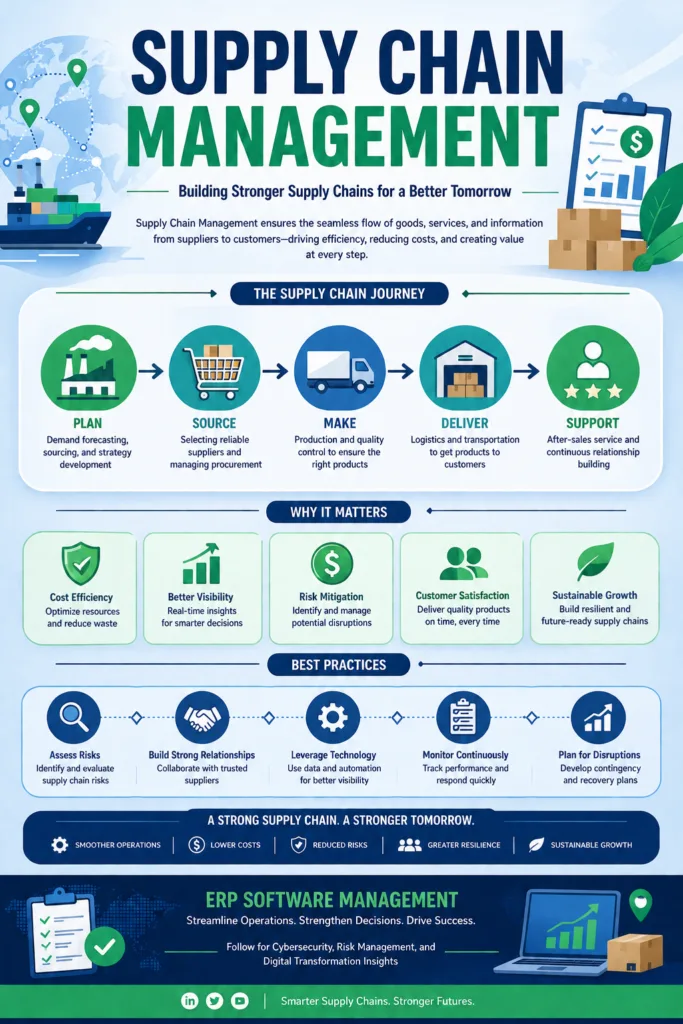
Supply Chain Management (SCM) operations are the engine of global trade. From procurement to logistics, warehousing to distribution, every step determines whether businesses deliver value, reduce costs, and satisfy customers. In 2026, SCM operations are not just about efficiency — they are about resilience, sustainability, and digital transformation. As the landscape of global commerce evolves, companies must adapt to new technologies and practices to thrive in an increasingly competitive environment. This includes leveraging data analytics for better decision-making, using artificial intelligence to optimize processes, and embracing sustainability initiatives to meet consumer expectations. In addition to the fundamentals of SCM, it’s imperative to understand the role of technology in enhancing these operations. For instance, advanced forecasting tools utilizing machine learning can predict shifts in consumer demand, enabling companies to adjust production schedules proactively. Furthermore, the integration of Internet of Things (IoT) devices allows for real-time tracking of goods, ensuring transparency and accountability throughout the supply chain. By investing in these technologies, businesses can not only streamline their operations but also improve their responsiveness to market changes. What Are Supply Chain Management Operations? Understanding SCM Operations in Detail Furthermore, the significance of sustainability in SCM cannot be overstated. Companies are increasingly recognizing the importance of sustainable supply chain practices not just for regulatory compliance but also for enhancing customer loyalty. For instance, brands that commit to environmentally friendly practices often see increased consumer trust and preference. Incorporating renewable resources into logistics, optimizing transport routes to reduce emissions, and minimizing waste are all practices that contribute to a more sustainable supply chain. Moreover, companies can leverage data analytics to improve their inventory management. By analyzing historical sales data, businesses can better predict demand trends and adjust their stock levels accordingly. This proactive inventory management not only reduces excess inventory costs but also minimizes the risk of stockouts, ensuring that customer demands are met promptly. In addition, considering the global nature of supply chains, companies must also be aware of geopolitical factors that can disrupt operations. Trade agreements, tariffs, and international relations can significantly impact sourcing strategies and logistics. Businesses must stay informed and agile, adapting their supply chain strategies to navigate these complexities. SCM operations involve multiple interconnected processes that collectively ensure the efficient movement of goods and services. Each stage, from procurement to distribution, plays a vital role in the overall supply chain. For example, effective procurement not only involves sourcing materials but also requires building strong relationships with suppliers to ensure reliability and quality. This relationship-building extends to evaluating supplier performance and making necessary adjustments to ensure that the supply chain remains uninterrupted. Why Are Supply Chain Management Operations Important? Moreover, SCM operations are increasingly becoming a focal point for businesses aiming to achieve sustainability goals. By optimizing logistics routes and reducing waste, companies can lower their carbon footprint. This shift not only meets regulatory requirements but also aligns with consumer demands for greener practices, thereby enhancing brand loyalty and market competitiveness. Supply chain management operations play a crucial role in the overall success of a business. They not only ensure the seamless flow of products but also impact customer satisfaction, operational efficiency, and financial performance. For instance, a well-optimized supply chain can reduce lead times and enhance inventory turnover, which directly translates into improved cash flow. Additionally, effective SCM operations can help mitigate risks associated with supplier dependencies and market fluctuations, enabling companies to respond swiftly to changes in demand or disruptions in supply. SCM operations encompass the end‑to‑end processes that move goods, services, and information across the supply chain. They include: Together, these operations form the backbone of modern business competitiveness. Furthermore, the concept of risk management within SCM operations is critical. Companies need to develop contingency plans to address potential disruptions, such as natural disasters or supplier failures. By diversifying their supplier base or incorporating flexible logistics solutions, organizations can build resilience within their supply chains, allowing them to recover quickly from setbacks. Key Components of SCM Operations 1. Procurement & Vendor Management Significance of Data in SCM Operations Sustainable Procurement Practices As sustainability becomes a priority for businesses worldwide, procurement practices must also evolve. Ethical sourcing, supplier diversity, and the evaluation of suppliers based on their environmental impact are critical components of modern procurement strategies. This not only helps in compliance with regulations but also enhances brand reputation and consumer trust. Data analytics has emerged as a game changer in supply chain management operations. By harnessing big data, organizations can gain insights into consumer behavior, track inventory levels in real-time, and forecast demand more accurately. For example, companies like Amazon utilize predictive analytics to optimize their inventory and ensure products are available when and where customers need them. This level of responsiveness can significantly enhance customer satisfaction and retention. 2. Production & Manufacturing Additionally, the role of employee training and development in SCM operations is often overlooked. Investing in workforce capabilities can lead to improved efficiency and innovation. Employees who are well-trained in the latest technologies and supply chain practices can identify areas for improvement and contribute to the optimization of processes. 3. Logistics & Transportation 4. Warehousing & Inventory Control 5. Distribution & Customer Fulfillment Challenges in SCM Operations Future Trends in SCM Operations Statistics That Matter Learn more about CIPS Procurement Training for insights on enhancing your supply chain management operations. The Role of Technology in SCM Operations Technology plays a pivotal role in enhancing supply chain management operations. With the advent of IoT, companies can achieve real-time visibility into their supply chains. This capability allows businesses to monitor inventory levels, track shipments, and respond to potential disruptions proactively. Furthermore, the integration of blockchain technology can enhance the traceability of products, ensuring transparency and trust among all stakeholders involved. Emerging Trends in Supply Chain Management Operations As we look towards the future, several emerging trends are expected to shape supply chain management operations. For instance, the rise of autonomous vehicles and drones in logistics is set to revolutionize delivery processes. Additionally, the focus on […]
Supply Chain Management Operations: From Strategy to Day‑to‑Day Execution Introduction to Supply Chain and Operations Management Between border shutdowns during COVID-19, a global semiconductor shortage, and the Red Sea shipping crisis that pushed Asia-to-Europe transit times up three- to five-fold, the period from 2020 to 2026 has stress-tested every link in global commerce. These disruptions made one thing clear: supply chain management and operations management are not back-office functions. They are the difference between keeping shelves stocked and watching revenue evaporate. Supply chain management coordinates the flow of materials and information from raw materials suppliers through production, warehousing, transportation, and final delivery to end customers. Operations management focuses on internal processes and efficiency, ensuring that what happens inside factories, warehouses, and fulfillment centers runs on time and within budget. Together, supply chain and operations cover every handoff, from tier-1 suppliers to the moment a customer opens a package. This article walks through the entire supply chain management process, from demand planning to performance measurement, in practical, business-focused language. Here is what you will learn: How daily supply chain operations work in practice, including the tools, roles, and metrics involved. How strategic decisions (network design, sourcing policy) differ from operational execution (production schedules, shipments) and why they must align. What recent disruptions teach us about resilience, trade-offs, and risk management. Where technology, people, and continuous improvement fit into the picture. Global value chains account for around 70% of international trade, which means that the way companies manage these flows directly shapes competitiveness, profit margins, and customer satisfaction. What Is Supply Chain Management Operations? Supply chain management operations refers to the day-to-day planning, execution, and control activities that keep the supply chain running. This includes procurement of materials, scheduling of production, managing logistics inbound and outbound, fulfilling customer orders, and handling returns. It is important to separate strategic supply chain management (decisions like where to build facilities, whether to outsource, and which markets to enter) from operational supply chain activities (daily scheduling, shipments, inventory moves). Strategy sets the playing field; operations play the game. Consider a 2026 consumer electronics brand sourcing semiconductors from Taiwan and plastics from Southeast Asia, assembling in Vietnam, and distributing into Europe. On any given day, the operations team must track chip lead times (often exceeding 20 weeks during shortages), schedule production batches, coordinate with shipping lines, replenish warehouses, promise delivery dates, and process returns for defective units. Scope: Procurement, production scheduling, inbound and outbound logistics, order fulfillment, reverse logistics. Objectives: Minimize cost (procurement, inventory carrying, transport), maximize service levels (on-time delivery, fill rate), build resilience (buffer capacity, dual sourcing). Typical KPIs: On-time in full (OTIF), order lead time, forecast accuracy, inventory turnover, supplier lead time adherence, capacity utilization, warehouse picking accuracy. Core principle: Supply chain management aims to deliver products efficiently and cost-effectively, and cost reduction comes from eliminating waste and optimizing inventory, especially as supply chain management operations in 2026 focus on efficiency, resilience, and sustainability. Components: Planning, sourcing, manufacturing, logistics, and returns management are the core components of supply chain management. It coordinates materials, data, and inventory movement across every node. Operations Management vs. Supply Chain Management Operations management focuses on internal processes and productivity: manufacturing lines, quality control, capacity utilization, and shop-floor scheduling. Supply chain management oversees external supplier and logistics interactions, spanning partners, carriers, warehouses, and customer delivery. Operations management is part of the broader supply chain management process, but the two require different lenses. Inside the facility, an operations coordinator and plant managers work on capacity, scheduling, and quality. Operations management ensures products are produced on time and efficiently, and it oversees manufacturing and warehousing facilities. Outside, the supply chain manager and logistics manager handle suppliers, warehouses, carriers, and cross-border flows. Operations managers coordinate with stakeholders to optimize processes on both sides of this boundary. Here is how they compare in practice: Scope: Operations management is internal (shop floor, lines, equipment capacity). Supply chain management is external (suppliers, carriers, distribution networks, customers). Time horizon: Operations decisions happen daily to monthly. Supply chain planning extends monthly to multi-year (network design, sourcing strategy). Main functions: Operations covers production scheduling, quality control, capacity management. Supply chain covers sourcing, logistics management, inventory across nodes, demand planning. Typical decisions: Operations asks “which jobs run next?” and “how many shifts?” Supply chain asks “which suppliers?” and “which transport mode?” Data used: Operations uses machine uptime, scrap rates, cycle times. Supply chain uses forecast data, lead times, freight costs, external risk indicators. A cross-functional example makes this concrete. Suppose a company in September 2026 plans production for December holiday demand. Operations must schedule overtime and weekend shifts. But procurement had to order chips from Taiwan 14 weeks earlier. Meanwhile, shipping lines rerouting from the Red Sea add transit time and cost. If logistics capacity is constrained, promised delivery dates need adjusting. The decision requires integrating internal operations with external chain management. Operations management ensures timely delivery of goods and services only when it is aligned with the supply chain. Main Functions in the Supply Chain Management Process The supply chain management process breaks down into five main functions, each with specific operational tasks that drive what operations teams do every day: Planning: Demand planning, Sales & Operations Planning (S&OP), setting inventory targets. This is where business goals meet resource allocation. Sourcing: Issuing RFQs, negotiating contracts, supplier performance reviews, releasing purchase orders. Sourcing involves selecting reliable vendors for raw materials and components. Effective procurement involves finding reliable suppliers for materials, and procurement and contracting best practices alongside supplier relationship management enhance supply chain efficiency. Production: Production scheduling, line balancing, quality control checks, maintenance planning. This is the manufacturing process in action. Distribution: Transport planning, route optimization, warehouse operations (picking, packing, shipping). Distribution is getting the final product to consumers or businesses. Returns: Reverse logistics flows, processing customer returns, recalls, refurbishing, disposal. Reverse logistics handles returned goods or items for recycling. Modern business operations teams rely on integrated data across these functions, typically through ERP and SCM systems like SAP […]
This warehouse manager course is built for 2026 supply chain environments where warehouse management can provide a competitive advantage and effective warehouse operations can enhance supply chain efficiency. The programme bridges operational tasks and supply chain strategy, helping you run an efficient warehouse, handle freight handling machinery safely, and apply the basic principles of inventory management in modern supply chains. It blends theoretical knowledge with integrated practical modules so you can acquire knowledge that translates into measurable results. Duration: 20–25 hours of structured study over 6 months (part-time) Delivery: Online lectures, case studies, and practical application exercises Assessment: 50-question exam, scenario assignments, and a layout design project Certification: Digital badge issued upon successful completion, valid for life Key outcomes: Improve efficiency in warehouse operations, reduce inventory costs, and decrease risk across business operations Course Objectives and Logistics Training Aims The logistics training aims of this course align with international best practice and address the critical skill gaps reported by 92% of supply chain organisations in 2026. Formal training provides measurable operational impact and reduces operational costs. Every objective is tied to a measurable outcome: Apply lean principles to eliminate waste in warehouse operations and drive continuous performance improvement, which is essential for operational efficiency Improve cost effectiveness by optimizing warehouse layouts to minimize operational friction-warehouse layout design focuses on space utilization and flow optimization Cover inventory optimization and loss prevention techniques, because effective inventory management minimizes carrying costs and prevents stockouts Use demand planning and forecasting as part of inventory management to maintain the correct quantity of stock ready for customer orders Implement safety measures and safety and housekeeping standards-health and safety training covers workplace risk reduction and equipment safety Track warehouse KPIs through performance management, including cost control, to deliver operational efficiencies and reduce warehouse costs Manage freight through optimized material flow across supply chain activities, following freight procedures that maintain freight integrity and secure freight during the whole process Who Should Enrol in a Warehouse Manager Course? Specialized training helps move from operational roles to management positions. This course will enable candidates at various career stages to advance, and can complement broader logistics and supply chain management training: Warehouse supervisors and team leaders ready to accept additional responsibility and step into managing staff across a distribution centre Forklift operators and stock controllers in the retail and wholesale sector or wholesale sector looking to demonstrate applied competence in broader warehouse management Inventory controllers in manufacturing, wholesale, and retail wanting skills required for a successful warehouse manager role-inventory management skills are essential across these sectors Junior supply chain analysts transitioning into operations at a retail distribution centre, 3PL, cold chain, or e-commerce fulfilment hub Warehouse roles typically require a combination of certificates and relevant experience. Prerequisites are minimal, though prior exposure to warehouse operations or inventory control systems is beneficial. A short supervisor course suits frontline staff; this comprehensive warehouse manager course suits those targeting supply chain management careers or preparing for strategic procurement and supply chain management certification. Core Curriculum: From Basic Principles to Advanced Warehouse Operations The curriculum moves from foundational theory to practical skills across every area a warehouse manager needs. Essential training covers inventory control, warehouse layout, and digital management systems. Successful managers blend technical knowledge with leadership and analytical abilities, while effective warehouse managers blend operational know-how with leadership skills. Warehousing fundamentals: Role of the warehouse in the supply chain, types of modern warehouses and distribution centres, flow from receiving to dispatch. Core workflows in operations management include receiving, picking, and shipping Inventory and stock management: Accurately count stock using cycle counting, maintain stock records, conduct either general stock counts or a financial stock take, and identify stock listed for replenishment. Covers maintaining stock through FIFO/FEFO, general stock counts, and financial stock management Specialist handling: Manage temperature controlled goods that require special temperature control in a temperature controlled environment, ensure correct hygiene for perishable items, and handle various packaging units by selecting the appropriate unit. Covers breaking bulk and managing packaging units Loss prevention and security: Implement security procedures, organisational procedures for decreasing risk, and security procedures that protect stock across the supply chain Picking, packing, and reverse logistics: Pick stock using batch, wave, or zone strategies; pack customer orders in correct quantity; manage returns for quality service and customer and product care Equipment and safety: Safe use of freight handling machinery, maintaining safety around conveyors and docks. Health and safety modules cover local regulations and equipment safety standards. Health and safety training is vital in warehouse management programs Digital systems: Warehouse management systems integrate automation and track inventory. WMS platforms, like ERP tools, are critical for operations. Logistics technology integration familiarizes students with digital tools. Adaptability to modern technology is crucial for warehouse managers seeking effective technological solutions and warehouse technology mastery Leadership: Leadership training develops skills in team supervision and performance tracking. People management includes supervising team members and managing operational overhead-key to managing staff at scale Course Structure, Duration, and Assessment The CWMP® Certification has no pre-requisites and requires 20 to 25 hours of study, making it accessible alongside shift work. The ASCM Supply Chain Warehousing Certificate includes 20 hours of online learning across 30 high-impact modules. The ASCM program consists of 30 modules covering the complete warehouse lifecycle. A recognized certification improves career credibility and networking opportunities. Detail CWMP® Certification ASCM Warehousing Certificate Study hours 20–25 hours 20 hours Modules Comprehensive 30 high-impact modules Exam 50-question, 70% pass Programme assessment Validity Lifetime Per ASCM guidelines Prerequisites None None A CWMP certification requires passing a 50-question exam with a 70% score. The CWMP® Certification requires a passing score of 70% and is valid for life. Assessments blend scenario-based questions with practical assignments-layout redesign, inventory analysis, and process improvement projects. Upon successful completion, each learner accredited receives a digital badge. Every person credited with the qualification meets a defined unit standard and the competencies acquired reflect practical application in real warehouse settings. This seta accredited course ensures graduates can successfully complete all […]