Supply Chain Department: Structure, Roles and Best Practices

Introduction: What the Supply Chain Department Does Today
A modern supply chain department manages the end-to-end flow of raw materials, information, and cash from supply chain partners to customers. It oversees the entire supply chain, covering demand planning, sourcing, production planning, logistics, reverse logistics, and returns – far beyond traditional purchasing and warehousing.
In 2020, effective supply chain management scm proved crucial during the COVID-19 pandemic, and companies recognized the need for modernized supply chains. Tariff changes in 2024–2025 further reinforced that an efficient supply chain is now a board-level priority. Supply chain management includes sourcing, production, and distribution processes, and effective SCM reduces waste and maximizes customer satisfaction through ensure timely deliveries and stronger risk management. Companies with effective SCM can achieve a competitive advantage. Professional standards from institutes like CIPS benchmark how a well-run department should operate, while modern scm frameworks guide organizations toward real time data-driven decision-making and improved supply chain efficiency.
The Purpose and Core Responsibilities of the Supply Chain Department
After 2000, many organizations in manufacturing, retail, and public sectors formalised supply chain departments to consolidate fragmented business functions. The disruptions of 2020 exposed weak links – lack of visibility, supplier risk, inventory fragility – expanding responsibilities to demand management, ESG compliance, and after-sales support. The supply chain department manages the entire lifecycle of a product, and a typical supply chain department includes planning, procurement, and logistics.
The overarching purpose is to design, operate, and continuously improve the supply chain management process so finished products and services reach customers reliably, ethically, and cost effectively. The five phases of SCM are planning, sourcing, manufacturing, delivery, and returns. Effective SCM aims to reduce waste and maximize customer satisfaction while SCM helps in maximizing efficiency and productivity. Four classic responsibility clusters define daily work: demand and supply planning, source and contract, make and move, and measure and improve. Effective SCM reduces costs by eliminating unnecessary steps across the entire process.
The department acts as a bridge between various departments – sales, marketing, manufacturing processes, service delivery, and finance – aligning supply chain activities with corporate strategy and resource allocation. It contributes directly to improve customer satisfaction by minimising stockouts, reducing lead times, and improving on-time delivery performance. In government and regulated sectors, the department safeguards compliance with the public finance management act and transparency standards. Modern teams rely on accurate supplier information and a central supplier database to coordinate the sourcing process and contract management across multiple sites.
Why You Need a Structured Supply Chain Department
Once annual spend, SKU count, and supplier numbers pass critical thresholds – more than 500 SKUs or multi-site supply chain operations – lack of structure causes duplication and missed accountability. A structured supply chain department minimizes waste and unnecessary spending by clarifying ownership of demand planning, the procurement process, inventory control, fleet management, and data analytics.
Dedicated teams for forecasting, strategic sourcing, and distribution enhance efficiency and reduce end-to-end lead time. Wal-Mart cut costs by 5-15% through direct sourcing from suppliers, demonstrating concrete efficiency gains from structured sourcing strategy. Cost control comes through standardised contracts, central negotiation, optimal order quantities, and network design – all levers that improve overall productivity and optimize processes for reducing costs.
Rising customer expectations drive the need for faster delivery times and high service levels. When the department is structured around customer requirements and product availability rather than internal cost targets alone, customer relationships and customer needs are better served, which helps improve customer service. Supply chain visibility is critical for tracking products in a multi-tiered network, and a structured department can systematically track supply risks. McKinsey’s 2025 Risk Pulse survey found 82% of firms reported being affected by new tariffs, while geopolitical instability can disrupt supply chains through increased tariffs and trade route disruptions. Global economic uncertainty impacts supply chain operations, including fluctuating oil prices, making supplier risk management – dual sourcing, safety stock, near-shoring – essential.
A European pump manufacturer reorganised planning and logistics under one Head of Supply Chain, implemented Kanban, and rolled out logistics software, achieving over 95% on-time delivery and halving throughput times. Centralised master data and a central supplier database provide visibility into contracts, supply chain performance, and compliance. Looking forward, this structure is foundational for continuous improvement, digital transformation, and automate processes initiatives using scm systems.
Key Functions Inside the Supply Chain Department
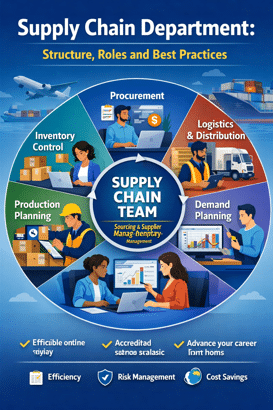
Most mid-to-large organisations group supply chain work into core functions that operate as an integrated system, each playing a crucial role in operational efficiency.
Demand Planning and S&OP. Demand planning and forecasting involves predicting customer demand using sales data, promotions, and market trends. Supply chain professionals coordinate production among multiple providers. S&OP balances demand, capacity, and inventory levels with finance expectations through production schedules and supply planning, delivering actionable insights and real time insights for performance management.
Procurement and Strategic Sourcing. Procurement specialists are responsible for sourcing materials and products, distinguishing between operational buying and strategic sourcing – running tenders, negotiating contracts, and supplier development. They evaluate supplier information on quality, cost, environmental affairs, ESG performance, and risk, supporting strong relationships with chain partners. They ensure minimal quality control or inventory problems and source materials aligned with environmental considerations and customer demand.
Inventory Management and Materials Planning. Inventory management ensures adequate stock levels and minimizes costs, while inventory management optimizes stock levels and minimizes carrying costs. Core functions of supply chain management include procurement, logistics, and inventory management. Techniques like just in time, vendor-managed inventory, and ABC analysis link directly to working capital and increased productivity. Supplier risk management involves monitoring supplier reliability and mitigating disruptions.
Logistics and Distribution. Logistics coordinators manage transportation and delivery of goods. Logistics involves managing transportation and delivery of goods across the network – transport planning, carrier management, warehouse operations, last-mile delivery, and optimize routes strategies. Performance here drives time delivery metrics, damage rates, and overall customer satisfaction.
Supporting Roles. Data analytics, master data management, and continuous improvement specialists track KPIs such as inventory turns, OTIF, and forecast bias. Modern supply chains increasingly rely on data analytics and technologies like AI for decision making, and AI can optimize inventory management and demand forecasting. In some organisations, customer service teams sit within the department to keep order-to-cash performance under one leader, helping improve efficiency across all business processes.
Roles, Skills and Governance in Supply Chain Management
Supply chain management is a professional discipline with defined roles, skill sets, and governance standards supported by global bodies such as CIPS. Supply chain managers oversee all supply chain activities and strategies, developing strategies to improve supply chain performance. They participate in sales forecasting and quality management as an integral part of operations management.
Senior leadership – Head of Supply Chain or Supply Chain Director – owns end-to-end strategy, network design, and alignment with corporate objectives. Supply chain managers handle day-to-day execution: KPI delivery, cross-functional coordination, and supplier relationships. Core professional roles include procurement and category managers leading sourcing strategies, demand planners balancing demand and supply, logistics and warehouse managers running physical operations, and inventory controllers maintaining stock integrity. Supply chain professionals must adapt to changes in production and shifting market conditions to maintain a competitive edge.
Critical competencies span analytical skills (forecasting, cost analysis), commercial skills (negotiation, contract management), technical familiarity with ERP and supply chain solutions, and soft skills like stakeholder management and ethical decision-making. Governance is essential: documented policies, segregation of duties, tender workflows, and audit trails prevent fraud and ensure compliance across both private and public organisations. Investing in training, certification, and continuous professional development keeps supply chain professionals aligned with evolving best practice – delivering the supply chain performance, increased productivity, and competitive advantage that today’s landscape demands.